Table of Contents
Intervention Summary
The Positive Peers Application (PPA) is a mobile health technology that features a varied set of tools, information, and support to a community of application users. PPA is designed for young people living with HIV (YPLWH), and guided by input from a Community Advisory Board of young people living with HIV. PPA aims to help users improve engagement and retention in care, achieve and maintain viral suppression, increase self-management of HIV, and reduce perceived stigma and isolation.
The PPA functions include health management tools such as medication reminders, educational blogs, relaxation videos, curated community resources, social networking in a community forum, private chat capabilities, user personalization, and user-controlled privacy.
The defining feature of Positive Peers is 24/7 access to a supportive community of young people with the shared lived experience of having HIV.
This mobile application provides users with connections to a network of trusted peers. These connections support users’ efforts toward uninterrupted retention in care, viral suppression, and fewer feelings of stigma and
isolation.
MetroHealth developed the app in partnership with Blue Star Design and Blackbird Digital. Outcomes evaluation was provided by Kent State University College of Public Health.
Rationale and Need
HIV remains a serious health issue for adolescents and young adults. In 2016, over 22,000 Americans between the age of 13 and 34 were diagnosed with HIV. [1]
Young adults have similar care patterns as older HIV patients but are less likely to have or adhere to an antiretroviral therapy prescription and achieve viral suppression. [2-4] Furthermore, younger people living with
HIV are less likely to use condoms or be tested for HIV, and more likely to have multiple sex partners.[4-6]
Among the newly diagnosed youth, 67% identified as gay or bisexual males, the majority of whom were Black (54%) or Hispanic/Latino (24%). Consequently, it is crucial to direct prevention and retention efforts toward engaging this demographic in care.
Among people living with HIV and receiving medical care, young people aged 18 to 24 are more likely than older people to be living in households with low-income levels. They tend to be homeless, recently incarcerated, uninsured, or only have Ryan White Program-funded health care.
Furthermore, gay and bisexual teens often report high-risk sexual activity, drug use, and being bullied more than their heterosexual counterparts. [2,14-15] It is not surprising that these same youth report feelings of isolation and lack support. [16]
Youth and young adults of color are disproportionately infected with HIV in Cuyahoga County, where Positive Peers is being evaluated. In 2015, 57% of the county’s new cases of HIV were under the age of 30 when diagnosed.[26] Of those young people, 99 (83%) were African-American.[26]
As young people, this demographic is already experiencing the typical challenges of transitioning into adulthood, such as affording education, finding and maintaining employment, and securing stable housing. [10,
21] These challenges are exacerbated when adding the burden of an HIV diagnosis and then navigating, likely for the first time, a complex healthcare system.
Younger people typically have little experience with disease self-management. They struggle to keep track of physician visit appointments, refill medications, and communicate with insurance carriers to gain access to
antiretroviral medications (e.g. prior authorizations). These challenges, combined with lower levels of health literacy, often result in inconsistent or out-of-care outcomes. [13,21]
All of these factors pose barriers to achieving viral suppression. [9-10] And it is compounded by the stigma associated with HIV and generally low HIV literacy among young adults. [11-13]
Stigma and misperceptions about HIV negatively affect the health and well-being of young people and may prevent them from disclosing their HIV status and seeking HIV care.
In a recent Kaiser Family Foundation survey, 51% of young adults aged 18 to 30 said they would be uncomfortable having a roommate with HIV. It found that 58% of these individuals would be nervous having their food prepared by someone with HIV. [5] And, the report indicated more than half of young people incorrectly believe that HIV can be transmitted by spitting or kissing.
Given all these challenges, there is a need for novel ways to create a safe and welcoming entry to care. And it must facilitate long-term, continuous, and coordinated care for young people living with HIV. [17-12] It’s clear that innovative approaches are needed to target this cohort for education, support, and treatment.
MetroHealth and colleagues are responding to this need via an ongoing community advisory board created to inform practitioners of community needs.
When asked, this community advisory board of YPLWH proposed creation of a mobile application for their phones that offered privacy, a safe place to engage with other YPLWH, and provided HIV-related health management tools.
The result of their request and continued guidance is the Positive Peers App. Recent innovations in technology and social media make it possible to engage this population in novel ways and with greater reach. The purpose of Positive Peers is to support retention in care, increase self-management of HIV, and reduce levels of perceived stigma and isolation among application users.
Theoretical Rationale
User activity is considered here as the mechanism for these desired outcomes. PPA community members who use the app more often and in more or personally meaningful ways are expected to report improved outcomes after a defined period of use. The rationale for these effects is based on well-supported theories of media effects, including social presence and media affordances.
Generally, social media applications can be characterized in terms of social presence (i.e., perceived intimacy and immediacy of interaction) and media richness (i.e., capacity to reduce uncertainty). [23] Social presence can increase if there is an opportunity for two-way communication and decrease if a participant can passively view forums or blog content. [23]
Furthermore, applications offering a broad complement of functions afford users a more significant opportunity to address felt needs. [24] In this way, app users can tailor their activity to their situation. [25] Applications
that provide both social presence and media richness are the most likely to afford the most significant potential for user activity. User activity is a key construct for linking mobile application use to desirable outcomes. It follows that a suite of well-designed functionalities–tailored to meet the needs of YPLWH–could offer a spectrum of varied opportunities to connect and learn from others.
In a review of literature focused on health outcomes associated with social media interventions in chronic disease management, Merolli et al summarized five general types of effects including:
1) Increased (web)site engagement
2) Improved social support
3) Greater disease-specific knowledge
4) Improved psychosocial outcomes
5) Improved physical condition [24]
The authors posit that these positive outcomes are the result of affordances provided by social media participation. [24]
Affordance theory is grounded in the premise that people do not interact with an object or person until they are aware of what actions are afforded by that channel. [25] This premise is highly pragmatic and emphasizes goal-driven behavior based on felt needs. Our users are motivated to interact based on the perceived affordances of the Positive Peers app.
This perspective led us to identify and combine multiple functionalities within a mobile application framework so to increase the likelihood of potential affordances and subsequent use.
Intervention Description
The Positive Peers Application (PPA) features health management tools, curated health information, and private and public social networking with other app users. Each general feature is organized in tabs, much like a web
browser.
Positive Peers provides health management tools that track healthy activities, sends discreet medication and appointment reminders, and provides overall wellness updates. These are found within the My Health section.
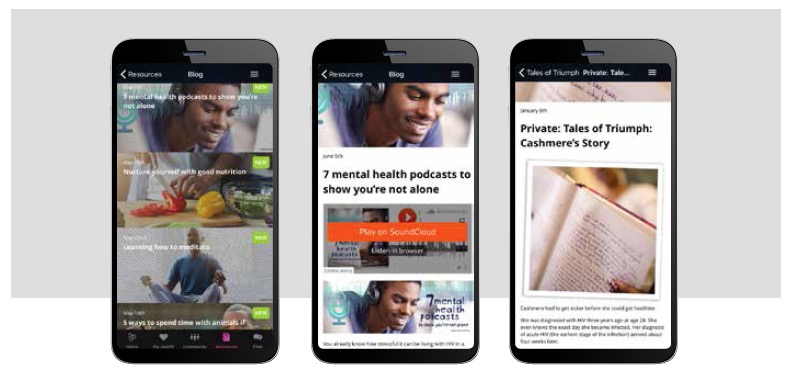
Within the resources section, Positive Peers provides accurate, easy-to-understand education blogs about living with HIV, health and wellness tips, relaxation videos, and patient stories. Additionally, the app provides curated local community resources such as housing assistance, support groups, food and clothing help, substance abuse programs, and a directory of the HIV care team.
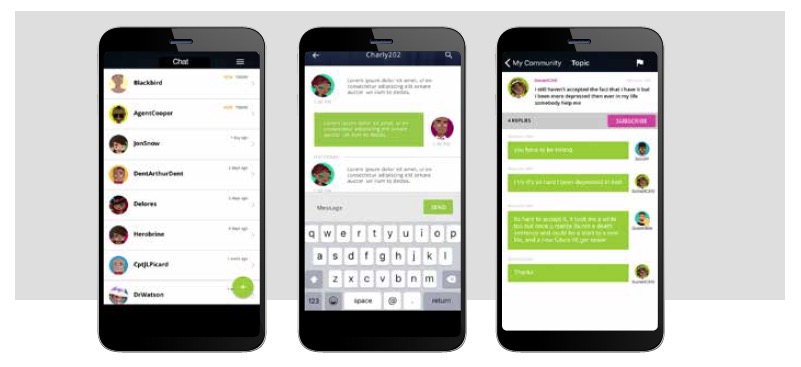
The most unique feature offered by Positive Peers is private social networking within community conversations and private chat sections. The virtual community allows users to communicate with each other, ask questions, post comments, and reply to one other in an ongoing thread of posts/replies. More private communication, in the form of direct message chat, is also available. This allows users to start or continue one-on-one private
conversations with more privacy.
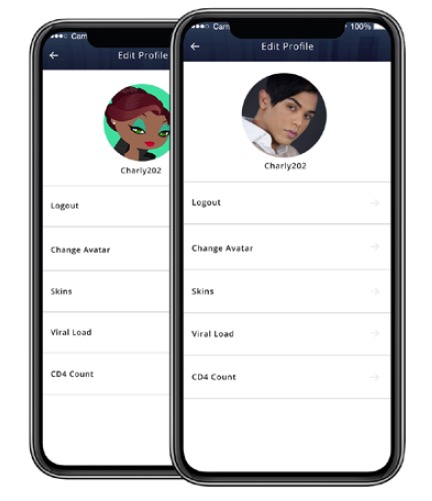 The app also includes a calendar of upcoming support groups, community events, and social gatherings. Positive Peers offers users numerous personalization & privacy options.
Participants can:
1) create their own username and passwords
2) choose to upload a personal picture or graphic avatar
3) choose a skin or color scheme for the app
A calendar with medication, exercise, and appointment reminders is customizable as well. Users decide how much personal information is shared on the app and with the community.
Implementation
Positive Peers is simple to implement. Extensive pre-implementation and quality improvement processes have gone into creating the app, website, social media, and blog. The following pre-implementation activities assure
that the PPA is reliable, tailored to the population, and meets ethical standards of privacy and confidentiality.
ONBOARDING: Potential users can now sign up through our easy, virtual onboarding process on the website.
SECURITY AND PRIVACY: Positive Peers secured necessary legal contracts, Business Associate Agreements, and HIPAA risk assessments with vendors to ensure that Protected Health Information (PHI) is kept secure. This includes hosting the application server behind MetroHealth’s secure firewall. The app does not store personally identifiable information. Users can choose to add information about themselves in the app.
CONTENT AND LANGUAGE: New blogs are written and posted regularly by Positive Peers. Topic ideas are solicited from users and healthcare providers. HIV health professionals approve all content. Material is written at a 5th-6th-grade reading level and some audio is provided for those who struggle with low health literacy. All messaging reflects an informal tone, upbeat language, and current slang used within our demographic. We incorporate pop culture references and emojis in genuine and appropriate ways. The goal is to provide YPLWH with reliable, relatable, non-judgmental, and non-confrontational information and tools for self-management and support. Positive Peers stays positive. This approach is part of the identity of Positive Peers and cannot be altered.
BRAND: The look and feel of Positive Peers is intentional. The detailed attention to the brand is to convey to users that they should expect reliable performance. The brand is trademarked. It is imperative that the brand remains consistent and not altered. This consistency helps users know that when they see Positive Peers, that it identifies a service from our organization and that they can trust that the quality is the same as the last time they interacted with our service. Positive Peers is easy to find online at positivepeers.org, and as PositivePeers4u on social media (@positivepeers4U on Facebook, Instagram, Twitter, and YouTube).
MARKETING AND RECRUITMENT MATERIALS: Positive Peers is marketed both in print and digitally. Print materials to date include a discrete cell phone-shaped pocket card with basic PPA information, Positive Peers branded cocktail napkins and condoms for distribution at events and local bars, and paper (8.5 x 11) flyers with HIV educational information (e.g., 3 facts we love about U=U, 4 steps to ensure you never run out of meds, etc.) for posting in healthcare facilities. Digital strategies included social media positing, boosted posts, and geo-targeted ads on local Craigslist, Jack’d, and Google ads. The most effective recruitment method is partnering with community HIV care teams, delivering presentations at HIV-related planning bodies, and tabling at LGBT Pride events.
COMMUNITY ADVISORY BOARD (CAB): Positive Peers relies on an ongoing, highly participative group of YPLWH to guide design and content as much as possible. CAB engagement was obtained at each stage of app development, including planning, design, implementation, and recruitment, and ongoing application engagement. The CAB continues to meet with staff biannually to give feedback regarding their own user experiences with the app’s functions and design, potential recruitment efforts, and perceptions of future digital content (e.g., blog topics). Positive Peers has also welcomed input from other local stakeholders (e.g., other clinicians, non-profits staff, etc.) to gather resources, promote local events, and suggested additional blog topics. This kind of ongoing feedback from multiple stakeholders is and will continue to be, an essential part of the app’s development and success.
STAFFING NEEDS: Since the app has already been developed, tested, launched, and is in use, the Positive Peers Key Health Partner Program can be implemented without the need for a dedicated staff person. A small amount of time from one staff person, such as a social worker or public health worker, would be required to complete app-admin activities (monitoring posts, answering questions, creating local event content, and being the person the local users know and are comfortable connecting with in the app).
Conclusion
The YPLWH community requested this mobile application, informed its design, and continues to refine its function. The resulting Positive Peers mobile application provides an engaging virtual community for young people living with HIV to share their experiences, broaden their literacy, and increase their tools for health management. Our multidisciplinary approach brings together highly competent and specific expertise to create, maintain, and evaluate this special technology. Positive Peers offers significant potential for supporting clinical relationships, improving health literacy, lessening stigma and isolation, and providing desirable interpersonal support needed to manage living with HIV.
References
- HIV Among Youth. Centers for Disease Control & Prevention; 2018. https://www.cdc.gov/hiv/group/age/youth/index.html. Accessed July 20, 2018.
- Beer L, Mattson CL, Shouse RL, Prejean J. Receipt of clinical and prevention services, clinical outcomes, and sexual risk behaviors among HIV infected young adults in care in the United States. AIDS Care. 2016;28(9):1166-1170. doi:10.1080/09540121.2016.1160028
- Ayres JRDM, Paiva V, França I, et al. Vulnerability, human rights, and comprehensive health care needs of young people living with HIV/AIDS. Am J Public Health. 2006;96(6):1001-1006. doi:10.2105/AJPH.2004.060905
- Zanoni BC, Mayer KH. The adolescent and young adult HIV cascade of care in the United States: exaggerated health disparities. AIDS Patient Care STDs. 2014;28(3):128-135. doi:10.1089/apc.2013.0345
- The Henry J. Kaiser Family Foundation. National Survey of Young Adults on HIV/AIDS.; 2017. National Survey of Young Adults on HIV/AIDS. Accessed March 8, 2018.
- Crepaz N, Marks G. Towards an understanding of sexual risk behavior in people living with HIV: a review of social, psychological, and medical findings. AIDS Lond Engl. 2002;16(2):135-149.
- Boyer CB, Greenberg L, et al. Exchange of sex for drugs or money in adolescents and young adults: an examination of sociodemographic factors, HIV-related risk, and community context. J Community Health. 2017;42(1):90-100. doi:10.1007/s10900-016-0234-2
- Buchacz K, Armon C, Tedaldi E, et al. Disparities in HIV viral load suppression by race/ethnicity among men who have sex with men in the HIV outpatient study. AIDS Res Hum Retroviruses. 2018;34(4):357-364. doi:10.1089/aid.2017.0162
- Iroh PA, Mayo H, Nijhawan AE. The HIV care cascade before, during, and after incarceration: a systematic review and data synthesis. Am J Public Health. 2015;105(7):e5-e16. doi:10.2105/AJPH.2015.302635
- Crepaz N, Dong X, Wang X, Hernandez AL, Hall HI. Racial and ethnic disparities in sustained viral suppression and transmission risk potential among persons receiving HIV care — United States, 2014. MMWR Morb Mortal Wkly Rep. 2018;67(4):113-118. doi:10.15585/mmwr.mm6704a2
- Vanable PA, Carey MP, Blair DC, Littlewood RA. Impact of hiv-related stigma on health behaviors and psychological adjustment among HIV positive men and women. AIDS Behav. 2006;10(5):473-482. doi:10.1007/s10461-006-9099-1
- Yehia BR, Rebeiro P, Althoff KN, et al. Impact of age on retention in care and viral suppression: JAIDS J Acquir Immune Defic Syndr. 2015;68(4):413-419. doi:10.1097/QAI.0000000000000489
- Rebeiro PF, McPherson TD, Goggins KM, et al. Health literacy and demographic disparities in hiv care continuum outcomes. AIDS Behav. 2018;22(8):2604-2614. doi:10.1007/s10461-018-2092-7
- Sullivan, K.A., Messer, L. C., & Quinlivan, E.B. (2015). Substance abuse, violence, and HIV/AIDS (SAVA) syndemic effects on viral suppression among HIV positive women of color. AIDS patient care and STDs, 29(S1), S42-S48.
- Hong, J.S., Kim, J., Lee, J.J., Shamoun, C.L., Lee, J.M., & Voisin, D.R. Pathways from peer victimization to sexually transmitted infections among African American adolescents. Western J of Nurs Res, 2018; doi.org/10.1177/0193945918797327
- Martinez J, Chakraborty R, The Committee On Pediatric Aids. Psychosocial support for youth living with HIV. Pediatrics. 2014;133(3):558-562. doi:10.1542/ peds.2013-4061
- Enane LA, Vreeman, RC, Foster C. Retention and adherence: global challenges for the long-term care of adolescents and young adults living with HIV. Curr Opin HIV AIDS. 2018;13(3):212-219. doi: 10.1097/COH.0000000000000459
- Lall P, Lim SH, Khairuddin N, Kamarulzaman A. Review: an urgent need for research on factors impacting adherence to and retention in care among HIV-positive youth and adolescents from key populations. J Int AIDS Soc. 2015;18(2(Suppl 1)). doi:10.7448/IAS.18.2.19393
- Hull MW, Wu Z, Montaner JSG. Optimizing the engagement of care cascade: a critical step to maximize the impact of HIV treatment as prevention. Curr Opin HIV AIDS. 2012;7(6):579-586. doi:10.1097/COH.0b013e3283590617
- Ryscavage PA, Anderson EJ, Sutton SH, Reddy S, Taiwo B. Clinical outcomes of adolescents and young adults in adult hiv care: JAIDS J Acquir Immune Defic Syndr. 2011;58(2):193-197. doi:10.1097/QAI.0B013E31822D7564
- Muthulingam D, Chin J, Hsu L, Scheer S, Schwarcz S. Disparities in engagement in care and viral suppression among persons with hiv: JAIDS J Acquir Immune Defic Syndr. 2013;63(1):112-119. doi:10.1097/QAI.0b013e3182894555
- Millett GA, Peterson JL, Flores SA, Hart TA, Jeffries WL, Wilson PA, et al. Comparisons of disparities and risks of HIV infection in black and other men who have sex with men in Canada, UK, and USA: a meta-analysis. Lancet 2012; 380:341–348. DOI: 10.1016/S0140-6736(12)60899-X
- Daft RL, Lengel RH. Organizational information requirements, media richness, and structural design. Management Science. 1986;32(5):554-571.
- 2Merolli M, Gray K, Martin-Sanchez F. Health outcomes and related effects of using social media in chronic disease management: a literature review and analysis of affordances. Journal of Biomedical Informatics. Dec 2013;46(6):957-969.
- Fox, J., & McEwan, B. Distinguishing technologies for social interaction: The perceived social affordances of communication channels scale. Communication Monographs, 2017; 84(3): 298-318.
- Cleveland Department of Public Health Office of Communicable Disease Surveillance and Epidemiology, Office of HIV/AIDS. 2015 HIV/AIDS Epidemiology Profile for Cuyahoga County and the City of Cleveland. 2016. 2015 HIV/AIDS Profile in Cleveland/Cuyahoga County